 TESTR
TESTRFrom Code to
Coverage,
Automatically.
TESTR reads your source code and builds a complete testing universe around it. Unit test cases, executable tests, AI failure analysis. No spec writing required.
By Flytebit Technologies · Alongside DOCKR and PASSR
def calculate_discount(
    price, rate
):
    if rate > 1 or rate < 0:
        raise ValueError(
            "Rate must be 0–1"
        )
    return price * (1 - rate)

# + 3 more functionsTHE PROBLEM
Testing debt compounds
silently.
Teams move fast, tests fall behind. The gap between code shipped and code verified grows every sprint - until production catches what CI missed.
Unit tests nobody writes
Developers intend to write tests. Tests get written on deadline, or skipped entirely. Coverage reports stay red and nobody talks about it.
Failures that explain nothing
CI goes red. The stack trace tells you what broke. Neither the CI nor the tests tell you why, or where to start looking.
Coverage metrics that lie
A function covered by one happy-path test looks identical to one with twelve edge cases. Lines executed is not behaviors verified.
Tests that decay with the code
You refactor a module. Three tests silently break. Two pass for the wrong reasons. Nobody notices until production.
Seniors lost to boilerplate
Your best engineers spend hours on PRs that add null checks and obvious edge cases. That time does not come back.
Test suites nobody trusts
Green CI is a formality. Everyone knows the suite is incomplete. Everyone ships and hopes for the best.
HOW IT WORKS
Backward from code.
Not forward from specs.
Every other testing tool starts from what you intend to test. TESTR starts from what you've already written and works outward.
TESTR reads your code
On every push, TESTR performs deep AST and semantic analysis across every changed function and method. No spec files, no annotations required - just your source code.
AI builds Unit Test Cases
For each function, TESTR generates structured Unit Test Cases: happy paths, boundary conditions, error scenarios, and security-relevant edge cases. It also produces executable test code: pytest, Jest, JUnit, NUnit, PHPUnit, RSpec, plus native test runners for Go, Rust, C, and C++. Mocks and stubs for all external dependencies included.
Tests run. Failures teach.
Approved tests run in your CI/CD pipeline. When something fails, TESTR produces a root cause explanation and a diff-ready code fix, with the full execution trace attached. Every failure feeds back into better coverage over time.
CORE CONCEPTS
A testing universe with layers.
Unit Test Cases
The atomic unit in TESTR. Each UTC describes one function, one scenario, and the expected behavior at that level. Every UTC has two faces: a human-readable description (id, purpose, risk, steps, expected result) and executable test code with mocks and assertions already generated.
Derived from code · Requires approval · Activates test execution
Failure Intelligence
When a test fails, TESTR goes beyond a red status. It locates the failing assertion, maps it to a code region, simulates the execution path, and produces a root cause explanation, a debugging narrative, a code fix, and an execution trace. Every patch is diff-ready and tied directly to the line that broke.
Root cause · Execution trace · Diff-ready code patch
Test Cases
Higher-level tests synthesized from clusters of UTCs. A TC represents a business scenario ("Payment retry on gateway failure") built from accumulated UTC knowledge. Tagged as smoke, regression, security, or performance.
Built from approved UTCs · Categorized and tagged
Test Suites
Bundles of Test Cases organized by purpose. TESTR auto-groups TCs into smoke packs for fast post-commit checks, regression packs for pre-release gates, and specialty suites for security and performance runs.
Auto-grouped · Suite-level execution tracking
CAPABILITIES
Everything needed to make testing automatic.
Zero-input UTC generation
No spec files, no annotations. TESTR reads your source and derives what to test from code structure, control flow, and dependencies.
11-language support
Python, JavaScript, TypeScript, Java, C#, PHP, Go, Ruby, Rust, C, C++. One platform across your entire stack.
Executable test code
Every UTC ships with runnable test code: pytest, Jest, JUnit, NUnit, PHPUnit, RSpec, plus native test runners for Go, Rust, C, and C++.
AI failure analysis
A test fails. TESTR produces root cause, execution trace, and a diff-ready fix. Not just a red light - a full diagnosis.
HITL governance
Every UTC is proposed by AI and activated only after approval in the TESTR portal. AI assists; your team decides what runs in CI.
CI/CD integration
Plugs into GitHub, GitLab, and Bitbucket via webhooks. Tests execute on push, results surface in the portal and inline on PRs.
Coverage and reporting
Execution history, pass/fail trends, flakiness patterns, and coverage at line, branch, and function level - across every repository.
Learning loop
From execution history and production signals, TESTR identifies untested paths and proposes new UTCs to fill coverage gaps over time.
INSIDE THE PORTAL
Real review surfaces, not a black-box test generator.
The portal is where teams inspect every UTC, compare source against generated code, and verify execution evidence before it becomes trusted automation.
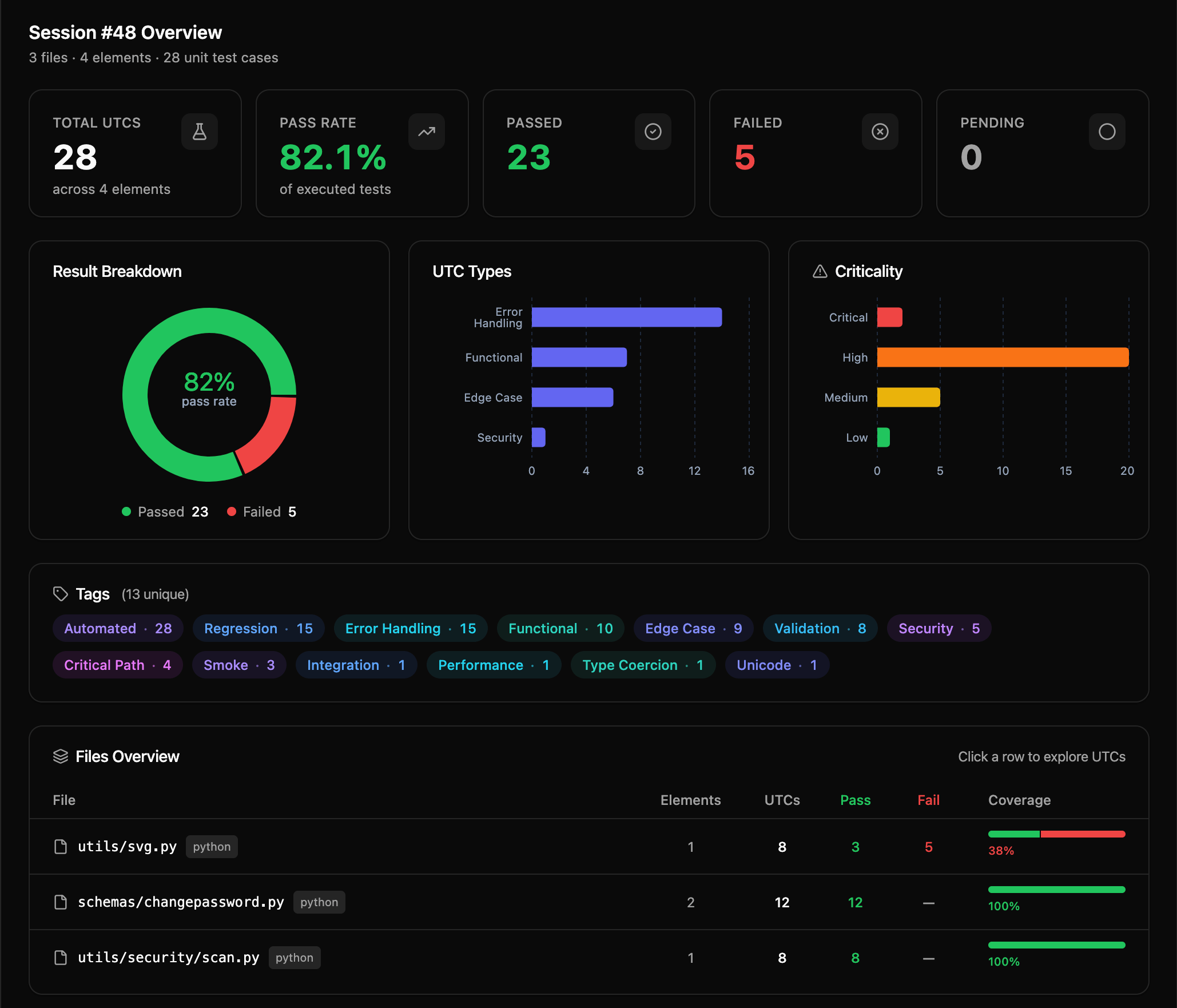
Track UTC volume, pass rate, criticality distribution, tags, and weak-file coverage from one session surface.
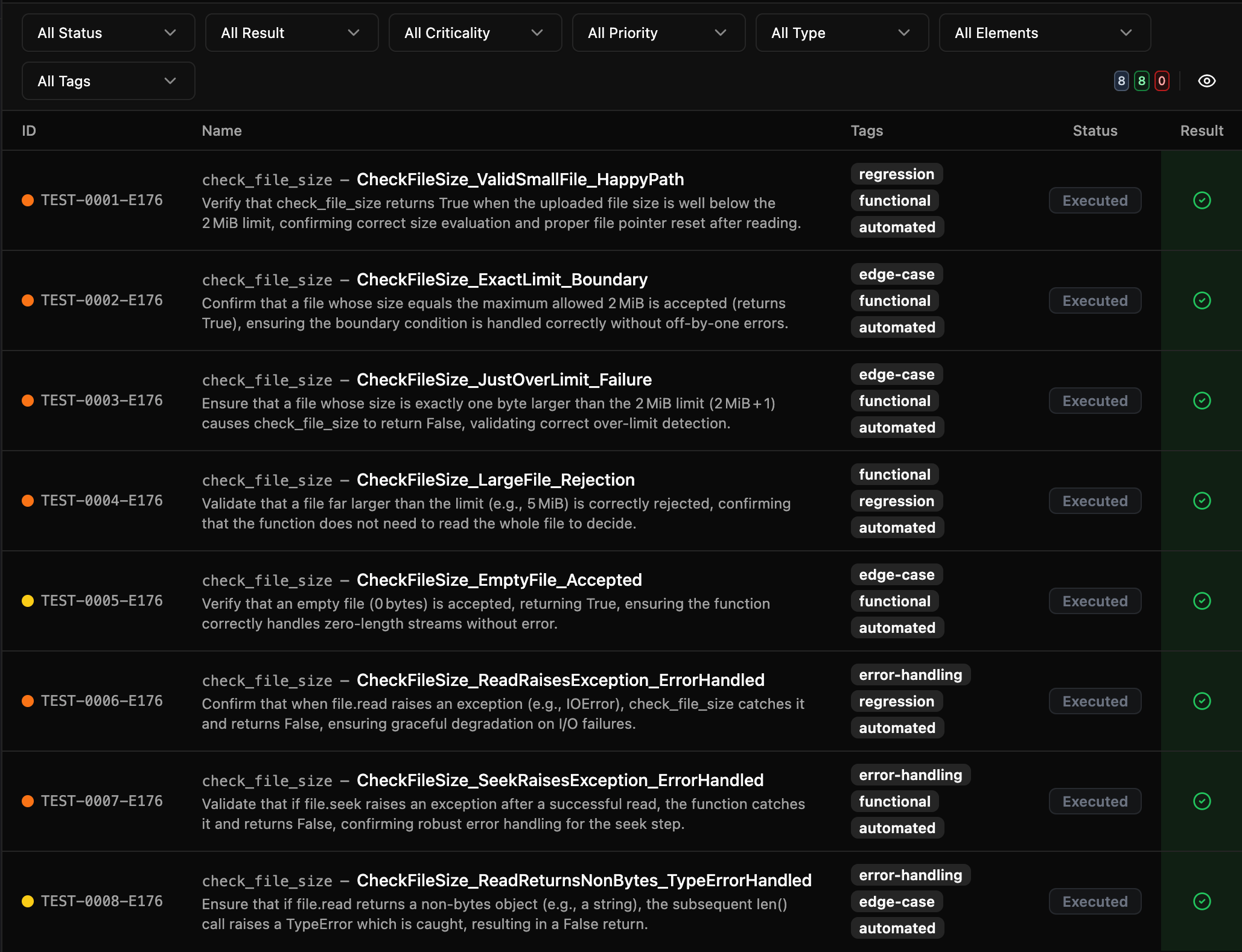
Filter generated UTCs by status, result, criticality, tags, type, and element so reviewers can move from signal to the exact case quickly.
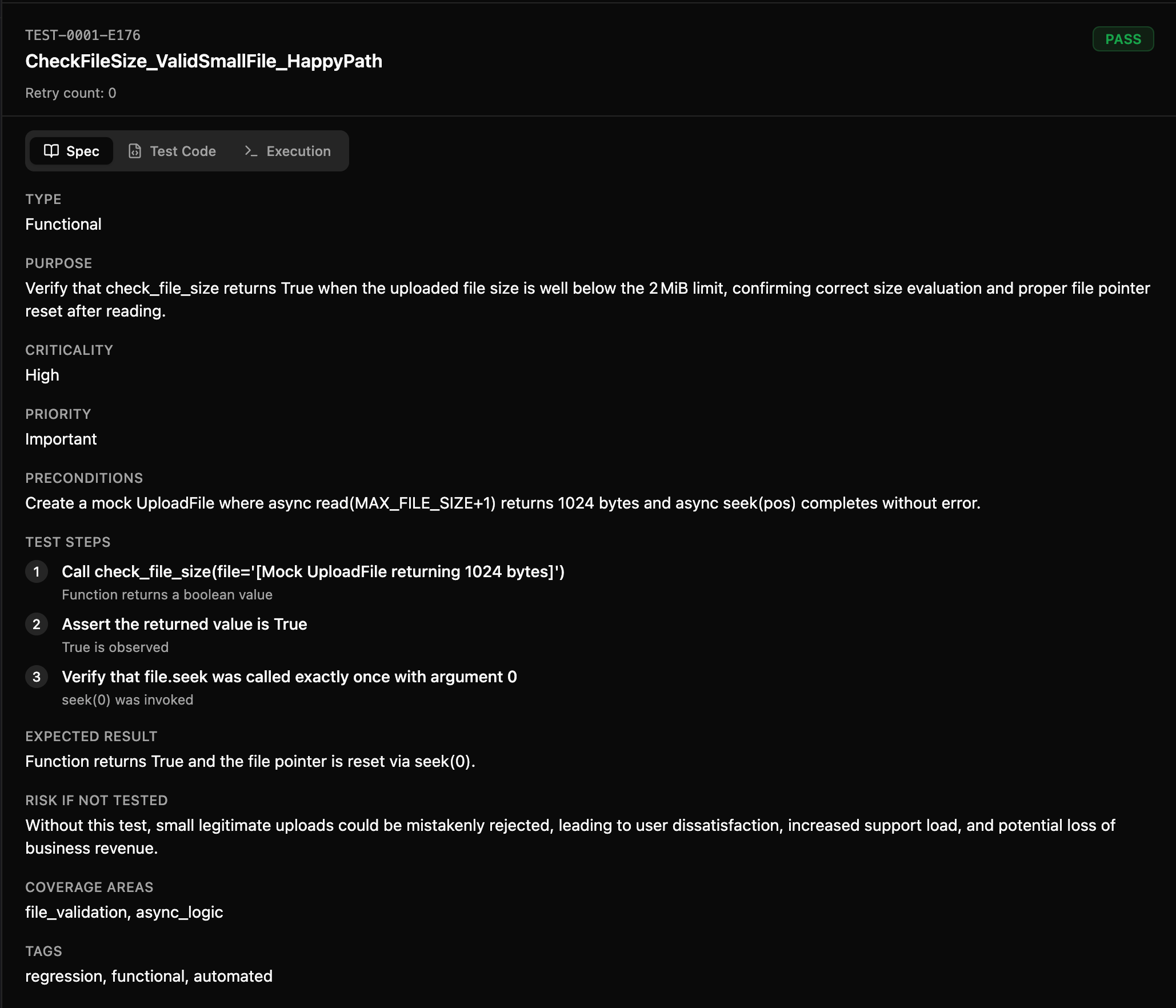
Inspect purpose, priority, preconditions, test steps, expected result, risk, and coverage areas before approving what runs.
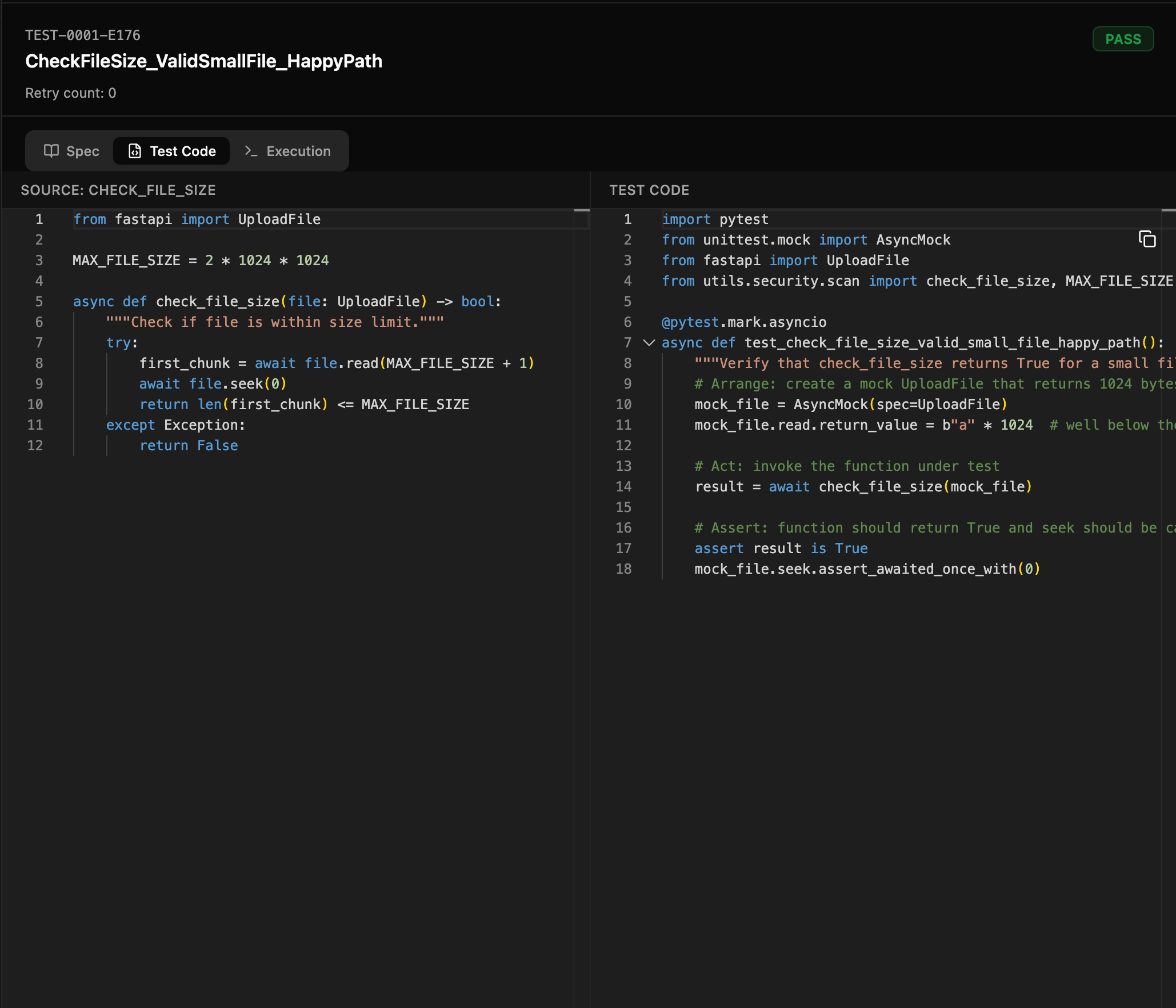
Review the original element code beside the generated test file to verify that mocks hold, assertions pass, and the behavioral intent is correct.
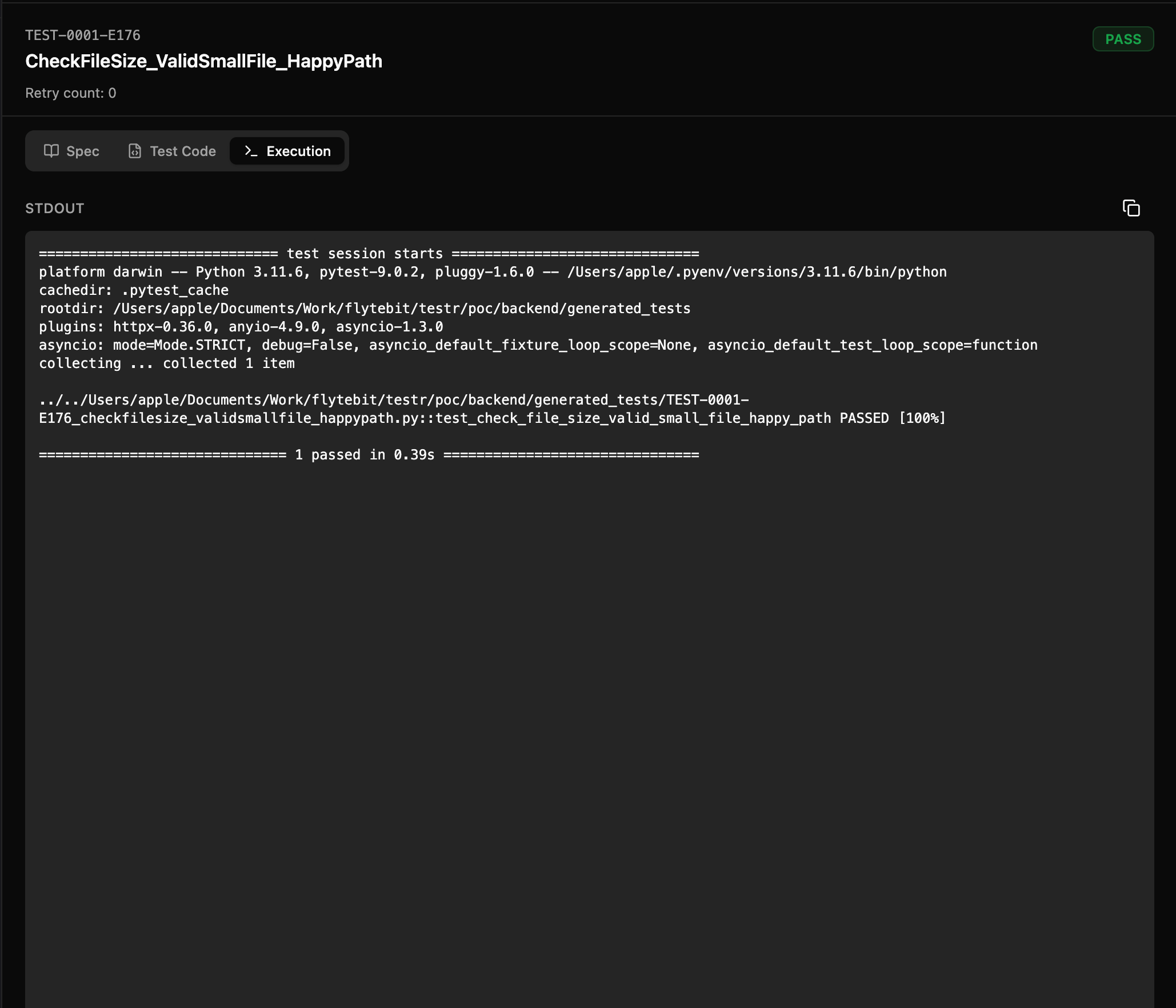
Open the runtime output for any UTC and see the actual test runner result, not just a pass or fail pill in a table.
WHO IT'S FOR
Teams that ship code
faster than tests.
Fast-moving startups
the gap
Three developers. No QA function. Unit tests are an afterthought until something breaks in production during a demo.
with TESTR
TESTR generates and runs tests automatically. Coverage grows with every commit. Your team writes code; TESTR makes sure it works. No testing hire needed.
Scale-ups with legacy debt
the gap
A codebase that has grown for four years. Coverage sits at 23%. Refactoring anything is a game of chance.
with TESTR
TESTR retrofits coverage onto existing code, identifies chronic failure zones, and builds a test suite that reflects how the code actually behaves.
Engineering leaders
the gap
You report on quality but you are measuring CI pass rates - not whether the right things are tested.
with TESTR
TESTR gives you coverage by function, trend data, failure patterns, and a portfolio view across every repository. Real metrics, not proxy signals.
TRUST & SECURITY
Your code stays
in your environment.
TESTR reads your source code to generate tests. That makes deployment model a security decision, not a pricing tier. Private deployment ships with every plan.
Private deployment
Run TESTR entirely inside your own VPC or on-premises infrastructure. Your code never reaches Flytebit servers.
Zero data egress
Test generation, execution, and failure analysis all run inside your network. No source code, test results, or execution traces leave your environment.
Full audit trail
Every UTC generation, approval decision, and execution event is logged. Complete traceability from source commit to test result.
WHY TESTING IS NOW A SECURITY PRACTICE
45%
of AI-generated code fails OWASP Top 10 security tests - across Java, JavaScript, Python, and C#.
Veracode 2025 GenAI Code Security Report84%
of developers are using or planning to use AI coding tools. More AI-written code means more untested surface area.
Stack Overflow Developer Survey 2025FAQ
Common questions.
TESTR is an AI-powered testing platform built by Flytebit Technologies. It reads your source code and automatically generates unit test cases (UTCs), executable test files, and AI failure analysis across 11 programming languages including Python, JavaScript, TypeScript, Java, C#, PHP, Go, Ruby, Rust, C, and C++. No spec files or test annotations are required.
On every code push, TESTR performs deep AST and semantic analysis across every changed function and method. It generates Unit Test Cases covering happy paths, boundary conditions, error scenarios, and security edge cases. It also produces ready-to-run test code for pytest, Jest, JUnit, NUnit, PHPUnit, RSpec, plus native test runners for Go, Rust, C, and C++, with mocks and stubs pre-generated for all external dependencies.
TESTR supports 11 programming languages: Python, JavaScript, TypeScript, Java, C#, PHP, Go, Ruby, Rust, C, and C++. Test output covers pytest, Jest, JUnit, NUnit, PHPUnit, RSpec, plus native test runners for Go, Rust, C, and C++.
A Unit Test Case (UTC) is TESTR's atomic testing unit. Each UTC covers one function and one scenario, and has two parts: a human-readable specification (purpose, preconditions, test steps, expected result, and risk level) and executable test code with mocks and assertions already generated. UTCs require human approval before they execute in CI.
When a test fails, TESTR's AI Failure Intelligence goes beyond a red status. It locates the failing assertion, maps it to the relevant code region, simulates the execution path, and produces a root cause explanation, a debugging narrative, a diff-ready code fix tied to the exact line that broke, and a full execution trace.
No. TESTR works backward from source code, not forward from intent. It requires no spec files, no annotations, no test configuration, and no manual test writing. Connect your repository and TESTR generates tests from what you have already written.
TESTR integrates with GitHub, GitLab, and Bitbucket via webhooks. Once a human reviewer approves a UTC in the TESTR portal, it runs automatically on every push to the relevant branch. Test results appear in the portal and inline on pull requests.
Yes. TESTR is designed for private deployment inside a customer's own VPC or on-premises infrastructure. Source code, test results, and execution traces never leave the customer's environment. Every UTC generation event, approval decision, and test execution is logged for a complete audit trail.
TESTR is live for
early adopters.
The MVP covers UTC generation, executable test code for 11 languages, AI failure analysis, and CI/CD integration. We're working with a small group to shape the platform before broader release.
No commitment. We'll reach out within 24 hours.